
That is where worldschooling hubs can make a huge difference.
Not because every traveling family needs a fixed program or a packed schedule. Most of us started this lifestyle because we wanted more freedom, not less. But kids need connection. Parents need other parents who understand the lifestyle. And sometimes, a good hub or community can turn a nice destination into a place you actually want to stay.
This guide is for families who are already traveling, planning a family gap year, homeschooling on the road, roadschooling, vanlifing, sailing, backpacking or just thinking about worldschooling for the first time.
What is a worldschooling hub?
A worldschooling hub is a place where traveling families come together for learning, community and shared experiences.
Sometimes it is an organized program with classes, workshops and a clear schedule. Sometimes it is a loose community in a beach town where families meet at playgrounds, cafes and local activities. Sometimes it is a pop-up event for one week. Sometimes it is just a destination that has become popular with worldschooling families because it works well.
In simple words: a worldschooling hub is a place where your kids have a better chance of finding other kids, and you have a better chance of finding other parents who understand your life.
That might sound small, but when you travel long term with children, it is huge.
Because after the first beautiful beaches, mountain views and cute old towns, most families run into the same question:
“Where are the other families?”
Why worldschooling hubs matter
You can worldschool anywhere. A museum, a forest trail, a local market, a ferry ride, a farm stay, a train journey, a national park, a city walk, all of that can become learning.
But community is harder to create by accident.
For many families, the learning part is not the biggest problem. Kids learn a lot on the road. They ask questions, they see new places, they hear different languages, they try new food, they learn geography without noticing it.
The harder part is often this:
- Finding friends with similar aged kids.
- Finding parents who do not think you are crazy.
- Finding a rhythm that does not burn everyone out.
- Finding places where kids can be kids, not just little tourists.
That is why worldschooling hubs are becoming such an important part of long-term family travel.
A good hub gives you:
- other kids nearby
- shared activities
- a softer landing in a new country
- local tips from families already there
- a break from planning everything alone
- a feeling of belonging, even if it is only for a few weeks
And honestly, sometimes that is exactly what keeps a family on the road longer.

The different types of worldschooling hubs
Not every hub works the same way. Before you choose one, it helps to understand the main types.
1. Fixed worldschooling hubs
These are places that run regular programs in one location. Families usually come for a few weeks or months. There may be learning sessions, outdoor activities, language classes, cultural experiences, parent meetups and free time.
This can be a great option if you want structure without going back to normal school life.
Good for:
- families who want a soft start
- kids who like regular faces
- parents who work online
- families who want community but not full-time group travel
Things to check:
- age range of the kids
- weekly schedule
- cost
- cancellation policy
- internet quality
- accommodation options nearby
- how much parent involvement is expected
2. Pop-up hubs
Pop-up hubs are temporary gatherings. They might last a weekend, one week or a few weeks. They can happen almost anywhere: a beach town, mountain village, city, campground or retreat space.
They are often more flexible and social than fixed hubs.
Good for:
- families already on the move
- meeting other worldschoolers quickly
- testing the community side of worldschooling
- adding a fun anchor point to your route
The challenge is timing. If you hear about a great pop-up two weeks too late, it does not help you much.
That is why live information matters so much in the worldschooling world.
3. Worldschooling camps and retreats
Some families prefer short, planned experiences. Camps and retreats can be great because the effort is lower. You arrive, the structure is there, the kids meet others, and you do not need to invent everything yourself.
These can be especially helpful if your kids are craving deeper connections, or if you want a clear start and end date.
Good for:
- first-time worldschooling families
- solo parents traveling with kids
- families who want a reset
- kids who enjoy group activities
Watch out for:
- programs that look better on Instagram than in real life
- very wide age ranges with no clear plan
- extra costs that are not obvious at first
- locations where you need a car for everything
4. Informal worldschooling communities
This is probably the most common version.
No official program. No fixed schedule. No big promise.
Just a place where many traveling families happen to be at the same time.
These can be wonderful. Sometimes better than paid programs. Kids meet at the beach every afternoon. Parents share tips. Someone starts a science activity. Someone else organizes a hike. You find a dentist, a babysitter, a good laundromat and three families going the same direction next week.
This is the kind of community many families are actually looking for.
But it can also be hard to find from the outside.
You often only hear about these places through word of mouth, WhatsApp groups, Facebook posts or other families you meet on the road.
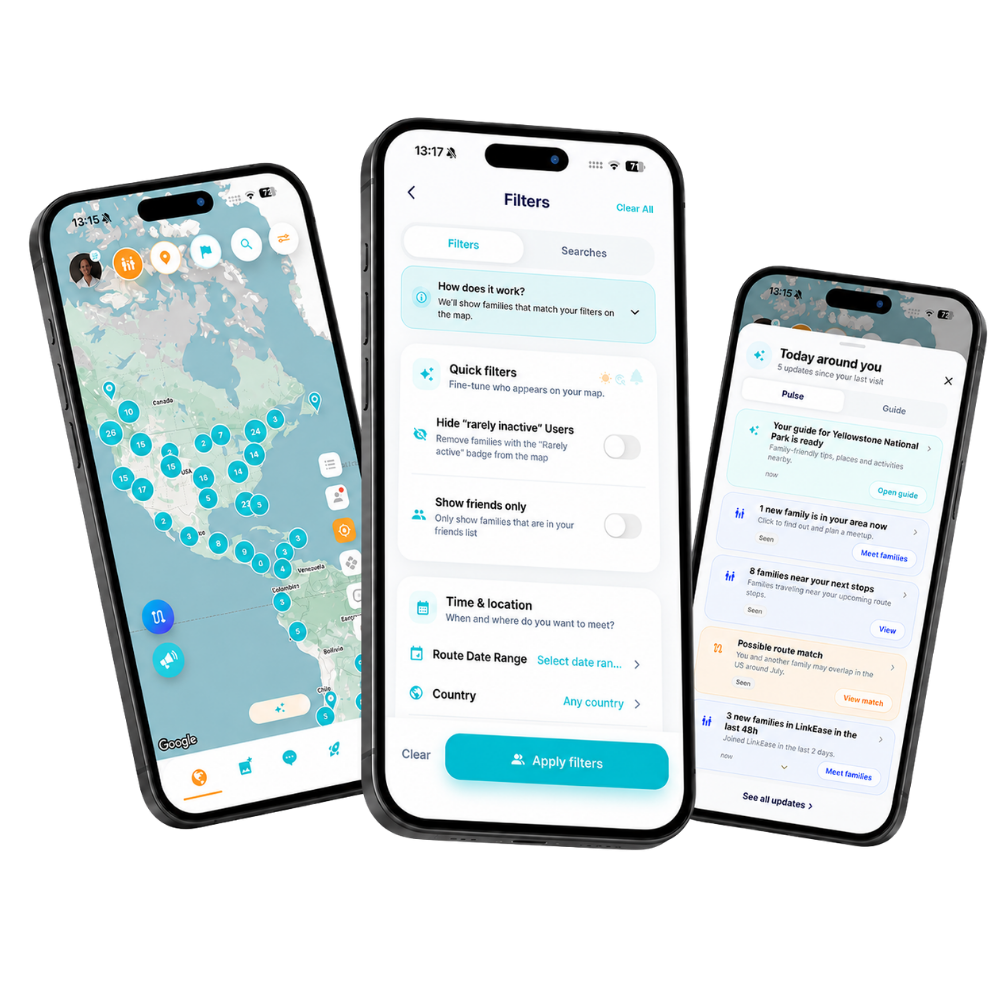
Looking for other worldschooling families nearby?
Download LinkEase and find traveling families, routes, hubs and family-friendly places around the world. Built for real family travel, not endless scrolling.
How to choose the right worldschooling hub
The best hub is not always the most famous one. It is the one that fits your family right now.
Here is what I would check before planning your route around a hub.
Age match
This is one of the biggest things. A hub can be full of families and still not work for your child if most kids are much younger or much older.
Before you go, ask:
- What ages are there right now?
- Are there kids in my child’s age range?
- Are teens included or mostly younger kids?
- Is it more preschool, primary age or mixed?
Travel style
Some worldschooling families stay three months in one place. Others move every few days. Some are in vans. Some are in Airbnbs. Some sail. Some backpack. Some follow warm weather. Some follow cheap flights.
Education style
Worldschooling means different things to different families. Some use online school, some homeschool, some unschool, some mix everything.
Cost
Worldschooling hubs can be free, low-cost or quite expensive. Always calculate the full monthly cost, including accommodation, transport, food, visas, insurance and activities.
Internet and work rhythm
If you work online, this can decide everything. Check internet speed, mobile data, coworking spaces, time zone and quiet work spots before committing.
Visa and entry rules
Always check official visa rules for your passport before you build your plan around a place.
Good worldschooling hub regions to research
I would be careful with any article that says “these are the best worldschooling hubs” and then gives one fixed list. The worldschooling scene changes quickly. Some places are amazing one season and quiet the next.
But there are regions that many families keep talking about because they work well for family travel, community and learning.
Spain and Portugal
Southern Europe is popular for a reason. Good weather, strong travel infrastructure, beaches, culture, history, nature and many family-friendly towns.
Spain and Portugal can work well for families who want a slower European base, especially outside peak summer.
- Andalusia
- Valencia region
- Catalonia
- Algarve
- Lisbon area
- Madeira
- Canary Islands
Thailand and Southeast Asia
Thailand has been popular with traveling families for years. It can be easy to travel, warm, affordable compared to many Western countries and full of learning opportunities.
Families often look at places like Chiang Mai, Koh Lanta and other slower areas with a family scene.
Mexico and Central America
Mexico, Guatemala, Costa Rica and other parts of Central America can be very attractive for worldschooling families.
There is Spanish language learning, strong culture, nature, volcanoes, beaches, wildlife and many slower places where families can stay for a while.
Bali and Indonesia
Bali is one of those places that gets mentioned all the time. Some families love it. Some find it too busy, too expensive or too social-media-heavy.
Bali can work really well if you choose the right area for your family and know what you are looking for.
South America
South America is full of worldschooling potential. Peru, Ecuador, Colombia, Argentina, Chile and Brazil all offer huge learning opportunities: mountains, rainforests, language, history, food, music, wildlife and strong local culture.

How to find worldschooling hubs without losing your mind
This is where many families get stuck.
You join ten Facebook groups, save fifty posts, open twenty tabs, message people on Instagram, then still have no clear idea where families actually are next month.
Step 1: Pick your region first
Do not search the whole world. Choose one region for the next two or three months, then search only within that region. This keeps planning realistic.
Step 2: Search for hubs, not just destinations
A family-friendly destination is not always a worldschooling hub. A place can have beaches, playgrounds and museums, but still no traveling families around.
Search for phrases like:
- worldschooling hubs Spain
- worldschooling community Portugal
- worldschooling families Thailand
- homeschool travel groups Mexico
- family digital nomads Bali
- worldschooling pop-up Europe
- roadschooling families USA
Step 3: Check if it is current
A blog post from three years ago might still rank on Google, but the community may have moved on. Look for recent posts, current dates, active comments, new reviews and families saying they are there now.
Step 4: Ask better questions
- Are there families with kids aged 6 to 10 in this area right now?
- Is there a weekly meetup?
- Do families stay here for weeks or just pass through?
- Is it easy without a car?
- Where do kids usually meet?
- Is there a Telegram or WhatsApp group?
- Are there any upcoming camps, hubs or pop-ups nearby?
Step 5: Use a live family travel app
This is exactly why we built LinkEase. Families should not have to dig through endless old posts just to find out if other kids are nearby.
With LinkEase, you can see traveling families, worldschoolers, routes, places and community spots in one app. You can find families near you, check kids’ ages, connect in chat and discover useful places for family travel.
What if there is no worldschooling hub nearby?
This happens a lot. And it does not mean the place is bad. Some of our best travel moments as families happen outside known hubs. The trick is to create little pockets of connection yourself.
Go where local families go
Playgrounds, libraries, swimming pools, sports clubs, skateparks, beaches, parks, children’s museums, climbing gyms and community events.
Start a small meetup
You do not need a big event. A simple message can be enough: “We are a traveling family with two kids, ages 7 and 10. We will be at the beach playground on Friday at 4 pm if any other families want to meet.”
Use learning as the reason to connect
Kids often connect faster when there is something to do.
- beach clean-up
- nature walk
- sketching afternoon
- board game meetup
- local food tasting
- museum visit
- animal spotting
- simple science experiment
- football in the park
Stay longer
Fast travel is exciting, but it makes community harder. If you leave every three days, you may see a lot, but your kids rarely get the chance to move from “hello” to real friendship.

Common mistakes families make with worldschooling hubs
Mistake 1: Chasing the famous place
A famous hub is not automatically the right hub. Look for fit, not fame.
Mistake 2: Expecting instant best friends
Community takes a little time. Even in a great hub, your child may need a few days to warm up.
Mistake 3: Planning too much
It is easy to arrive in a hub and say yes to everything because you are excited. Leave space. Kids also need boring afternoons, free play and time to process.
Mistake 4: Forgetting the parents
Worldschooling community is not only for children. Parents need connection too.
Mistake 5: Ignoring your child’s feedback
Sometimes we love a place and our kids do not. Sometimes they love a place we find boring. Listen to them.
A simple checklist before choosing a worldschooling hub
Community
- Are families there right now?
- Are there kids close to my children’s ages?
- Is there a weekly meetup or group?
- Is it easy to contact other families?
Learning
- Is there a program, or is it informal?
- Does the style match our family?
- Are there local learning opportunities?
- Can we keep up with our own homeschool or online school rhythm?
Daily life
- Is accommodation realistic?
- Do we need a car?
- Is internet good enough?
- Are groceries, laundry and health care manageable?
- Is the area safe and comfortable for kids?
Costs and logistics
- What is the full monthly cost?
- Are activities included?
- Are there hidden extras?
- How long can we stay?
- What are the visa rules?
- Is it easy to leave if it does not work?
How LinkEase helps worldschooling families find community
Worldschooling is beautiful, but the planning can be messy.
Families are spread across Facebook groups, WhatsApp chats, Instagram, old spreadsheets, blog posts, Google Maps lists and random recommendations from people you met three countries ago.
LinkEase brings the important parts together. You can:
- find other traveling families nearby
- see families by route and future plans
- filter by kids’ ages and travel style
- discover hubs, places, camps and family-friendly spots
- chat with other families
- plan meetups without posting your exact location publicly
- use the app while actually traveling, not just while planning at home
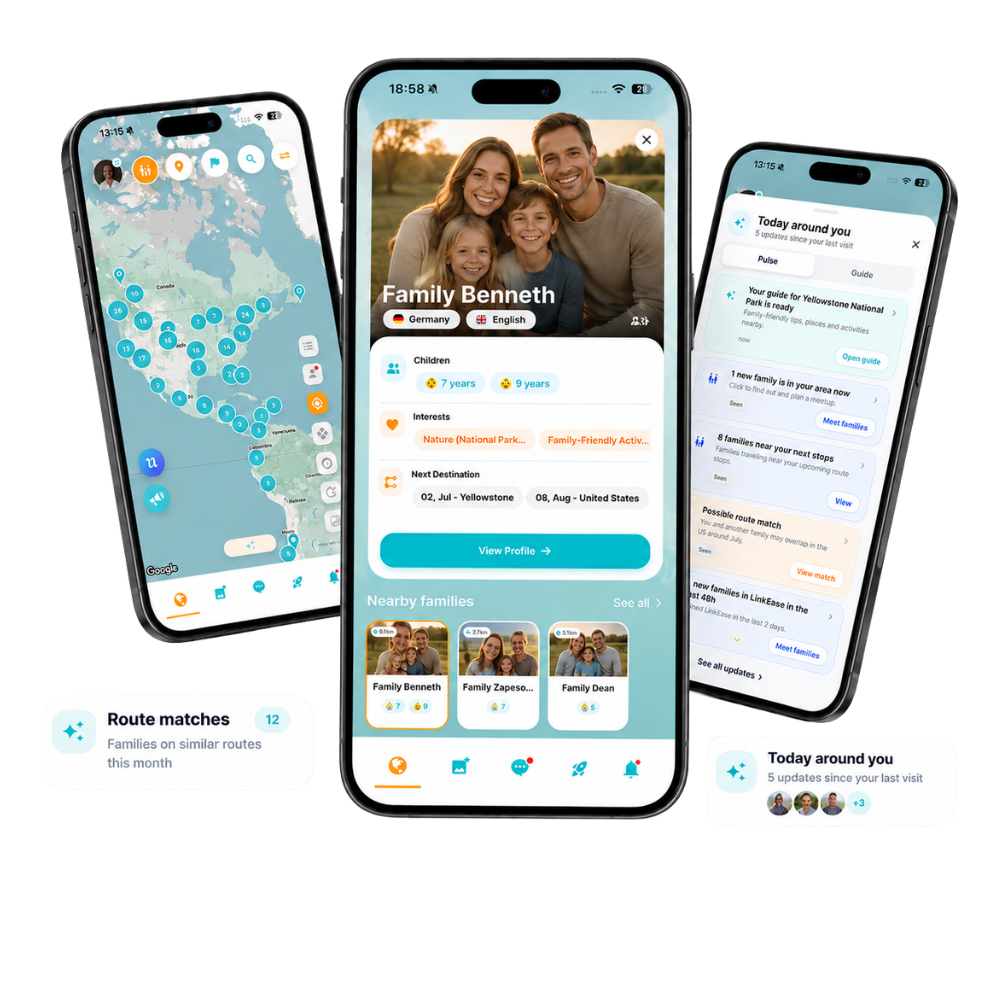
Traveling with kids and wondering where the other families are?
Download LinkEase and find worldschooling families, hubs, routes and family-friendly places around the world.
Final thoughts
Worldschooling hubs are not magic. They will not fix every hard travel day. They will not remove the need for planning. They will not guarantee instant friendships or perfect learning moments.
But they can make this lifestyle feel less lonely. And for many families, that is the missing piece.
So yes, visit the temples, the beaches, the museums, the forests and the old towns. But also look for the playground where other traveling kids meet. Look for the family who is going the same direction. Look for the hub, the camp, the pop-up, the little community that makes a place feel like home for a while.
And when you cannot find it, open LinkEase. Maybe the next family is closer than you think.
FAQ about worldschooling hubs
What are worldschooling hubs?
Worldschooling hubs are places where traveling families gather for community, learning and shared experiences. Some hubs are organized programs with classes or activities. Others are informal communities in destinations that attract many worldschooling families.
Are worldschooling hubs only for homeschoolers?
No. Many families who use worldschooling hubs homeschool, but not all. Some use online schools, some follow national distance learning programs, some unschool, and some travel during school breaks.
How do I find worldschooling hubs near me?
You can search online, ask in worldschooling groups, check hub directories, follow family travel communities and use apps like LinkEase to find traveling families, places and routes near you.
Are worldschooling hubs expensive?
Some are free or informal, while others charge for programs, classes, camps or retreats. Always calculate the full cost, including accommodation, transport, food, activities and visa costs.
What is the best country for worldschooling?
There is no single best country. It depends on your budget, visa options, children’s ages, travel style, weather, internet needs and the kind of community you want.